
Oshek: The Jewish Value of Protecting Workers
What is Oshek?
A foundational principle in Jewish tradition is the prohibition against exploitation. Oshek (literally oppression or exploitation in financial and business relationships), is rooted in the Torah and rabbinic literature and acknowledges that economic relationships often involve unequal power, creating the potential for exploitation.
In the context of Jewish food ethics, the concept of oshek invites us to look beyond what we eat and consider how the people who produce our food are treated. When workers are underpaid, overworked, or placed in dangerous conditions, the food system itself becomes ethically compromised.
Principles of Jewish Labor Justice
Jewish tradition offers extensive guidance about labor justice—the ethical treatment of workers and the responsibilities of employers. The sources highlighted below are not exhaustive, but they illustrate a consistent, clear legal and moral priority: protecting the dignity, welfare, and livelihood of those who work. Across the Torah and rabbinic literature, economic relationships are understood as places where exploitation can easily occur—and therefore as areas where strong ethical boundaries must be established.
Timely Payment
One of the most basic requirements is the obligation to pay workers on time. The Torah explicitly prohibits withholding wages from laborers and instructs employers to ensure that workers receive their pay promptly (Leviticus 19:13 and Deuteronomy 24:14–15). These laws recognize that many workers depend on daily wages to meet immediate needs. Delaying payment is considered a form of exploitation because it takes advantage of someone whose livelihood and well-being depend on that income.
Anti-Oppression
The Torah repeatedly warns against taking advantage of those with less social or economic power. This broader ethical concern appears 36 times, beginning in Exodus, where the Israelites are commanded not to oppress vulnerable people in their society, particularly strangers and migrants (Exodus 22:20, 23:9, etc).
Jewish tradition grounds this prohibition in collective memory: having experienced oppression in Egypt, the Israelites are instructed to build a society that does not replicate those harms. Within labor relationships, this principle translates into a responsibility to protect workers who may lack the resources or power to advocate for themselves. This concern lies at the heart of the prohibition against oshek: the use of power or position to impose unjust conditions on someone who depends on the relationship.
Fair Expectations
Rabbinic tradition further expands these protections by addressing the standards placed on workers. The rabbis recognized that exploitation can occur not only through wages, but also through unreasonable demands on a worker’s time and labor. The Mishnah teaches, for example, that employers cannot require laborers to begin work unusually early or continue unusually late if such expectations fall outside the accepted norms of the community (Bava Metzia 7:1). This principle reflects an understanding that fairness in labor includes humane working hours and reasonable expectations.
Rest
Jewish law also embeds worker protections into the sacred rhythms of time. The weekly observance of Shabbat mandates rest not only for landowners but also for laborers, animals, and others within a household or community. The agricultural cycle of Shmita similarly calls for a periodic release from agricultural production and includes mechanisms for economic redistribution. Together, these commandments envision a society in which productivity never overrides human dignity, and in which all members—including the most vulnerable—are entitled to rest and relief from constant labor.
Applying Oshek to Jewish Food Ethics
Today, most food system workers are not independent farmers with autonomy over their labor. Many are employees working within highly consolidated industrial supply chains with limited ability to advocate for better conditions or fair compensation.
The concept of oshek gives us a framework for identifying exploitative practices within this system. At the same time, we must acknowledge that the industrial food system is relatively new. The rabbis who interpreted Torah law could not have imagined global supply chains, factory farming, or multinational agribusiness corporations.
Just as Jewish tradition offers guidance on animal welfare through the principle of tza’ar ba’alei chayim, the prohibition of oshek helps us evaluate how modern food production affects human workers. Ancient wisdom impels us to evaluate the consequences of industrial agriculture and develop an ethically informed response as a community.
Worker Justice in Today’s Food System
Many sectors of the American food system carry significant human costs, none more so than industrial animal agriculture. The millions of workers who farm and process the majority of the meat, poultry, and seafood found in our grocery stores face conditions that raise serious concerns when viewed through the lens of oshek.
Contract Poultry Farmers and the “Tournament System”
Many chicken farmers operate under contracts with large corporations that control nearly every aspect of production. Growers are often placed in a “tournament system,” where farmers are ranked against each other and paid based on how efficiently they raise birds relative to others in the system.
This structure can saddle farmers with significant debt for building and maintaining poultry houses while leaving them virtually no control over the terms of production. Some farmers have spoken out about the financial pressure and lack of transparency in these contracts. A prominent example is Craig Watts, a former contract chicken farmer who publicly criticized practices within the industry after years of financial strain whileunder contract with Perdue Farms. By speaking out, Watts drew national attention to the power imbalance built into these agreements.
Dangers of Meat and Poultry Processing Plants
Slaughterhouses and meat processing facilities are among the most dangerous workplaces in the United States. Workers frequently face high rates of injury, including cuts, amputations, and repetitive stress injuries. Investigations by organizations such as Oxfam International have documented how poultry workers often lack basic protections, including adequate bathroom breaks and medical leave. Their campaign, “Lives on the Line,” highlighted these as systemic issues across the poultry industry.
Research by sociologist Timothy Pachirat in his book Every Twelve Seconds revealed how the speed and structure of industrial slaughterhouse work can place both workers and animals under extreme stress. These inequities became even more visible during the COVID-19 pandemic, when processing plants became hotspots for infection and higher risk of injury from increasing processing line speeds. In recent years, federal policy changes have moved toward making these already untenable speeds permanent, a shift that worker advocates warn will further endanger employees while also raising food safety concerns.
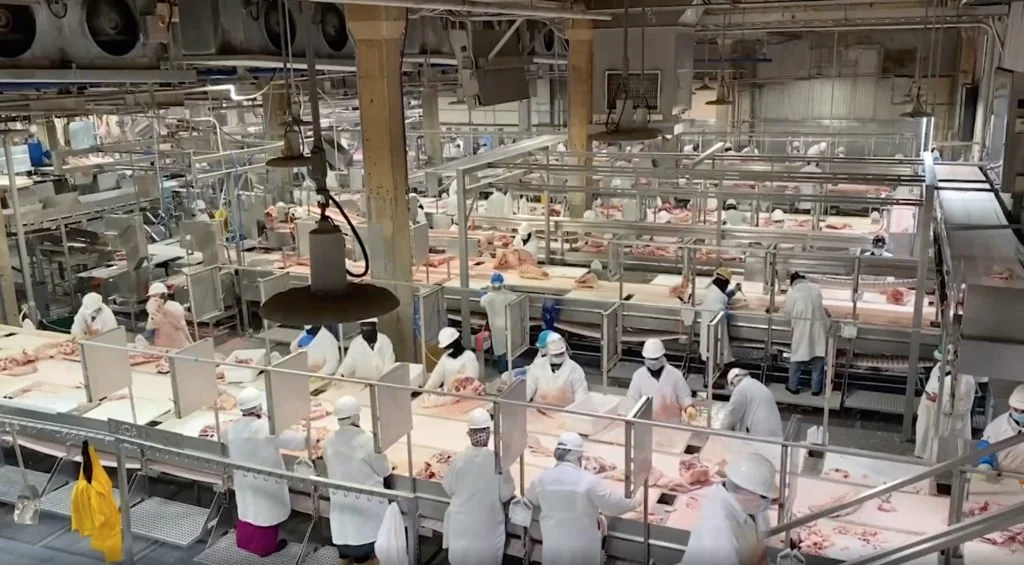
Source: PBS
Exploitation in Commercial Fishing
Commercial fishing is often even more dangerous than slaughterhouse work. According to data from the U.S. Bureau of Labor Statistics, fishing and hunting have the highest occupational fatality rates in the United States.
Globally, the fishing industry also faces serious problems with forced labor and human trafficking. The National Oceanic and Atmospheric Administration (NOAA) has acknowledged that forced labor and human trafficking are significant concerns in seafood supply chains. Because the United States imports the majority of its seafood, much of the labor behind these products occurs in environments with minimal oversight or worker protections.
Injustice Leads to Further Injustice
Labor exploitation in the food system rarely exists in isolation. When companies cut corners to maximize production and minimize costs, those pressures often cascade across multiple areas—affecting workers, animals, the environment, and communities alike.
A well-known example occurred at the kosher meatpacking company Agriprocessors in Postville, Iowa, which in the mid-2000s was the largest kosher meatpacking facility in the nation. While the public may remember the plant falling under scrutiny when graphic videos of animal cruelty surfaced through People for the Ethical Treatment of Animals (PETA), authorities had also been documenting repeated labor violations at the facility.
Those labor abuses eventually contributed to a massive immigration enforcement raid that temporarily shut down the plant in 2008. The plant reopened as Agri Star under new ownership shortly thereafter and has continued to be cited for environmental violations. The case revealed how systemic exploitation—of workers, animals, and local communities—can become normalized within high-pressure production environments.
As Pachirat describes in Every Twelve Seconds, slaughterhouse workers themselves often experience deep psychological distress as they perform repetitive acts of killing animals at industrial speeds. Many take these jobs simply to survive economically, not because they wish to participate in such work. Recognizing this complexity reminds us that ethical food systems must account for both human and animal suffering.

Matthew Walleser, CC BY 2.0 <https://creativecommons.org/licenses/by/2.0>, via Wikimedia Commons
Building a More Just Food System
Many organizations are working to improve labor conditions throughout the food system. Supporting these efforts can help advance a food economy that reflects Jewish values of dignity, fairness, and rest.
Some organizations aligned with these goals:
HEAL Food Alliance – A national coalition working to transform food and farm systems so they are healthy for people, fair to workers, and sustainable for the environment.
Socially Responsible Agriculture Project – Provides support to communities confronting the environmental and social impacts of industrial agriculture.
Food Chain Workers Alliance – Advocates for fair wages and safe working conditions across the food supply chain and promotes initiatives like the Good Food Purchasing Program.
Oxfam America – Through campaigns such as Lives on the Line, Oxfam has drawn attention to unsafe conditions facing poultry workers.
Take Action for Your Community
Jewish tradition calls on us not only to avoid exploitation but also to help build systems that promote justice and dignity and ensure that those who grow, process, and prepare our food are treated with fairness and respect.
One important way Jewish communities can contribute to a more ethical food system is by reducing demand for industrial animal production, which drives many of the labor conditions described above.
By supporting plant-forward food choices and advocating for responsible sourcing, communities can help move the food system toward practices that honor both people and animals.
Ready to learn how to better align the food practices in your community with Jewish values? Check out our new e-course that provides actionable strategies for Jewish communal dining programs.
This post contains Bookshop affiliate links, and purchases made by clicking on these links help support CJFE. Check out more of our book recommendations here.
